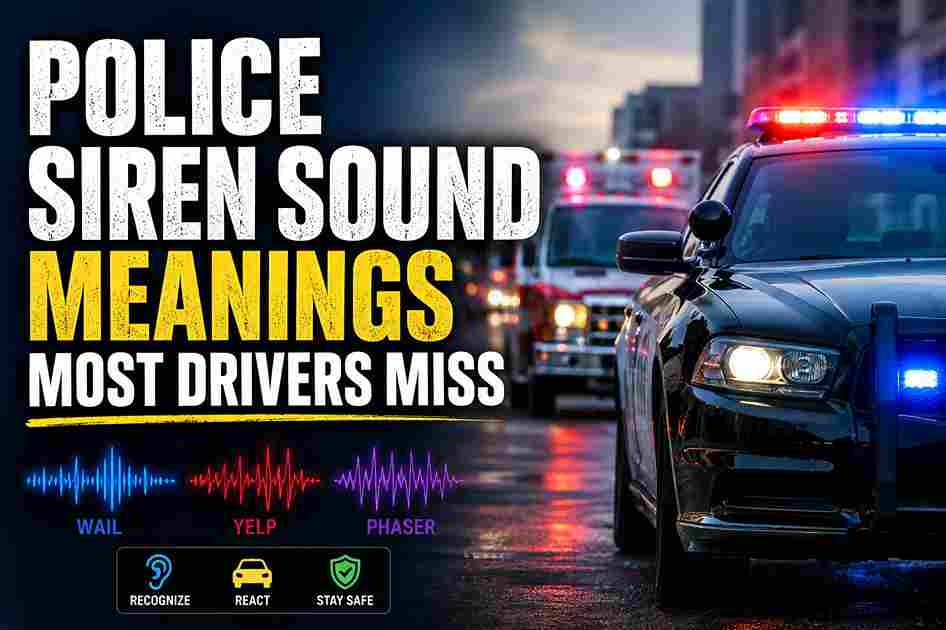
A driver sits at a red light during rush hour when a distant siren begins to rise and fall. Within seconds, the sound changes to a rapid, urgent burst. Cars start moving aside as a police cruiser weaves through traffic. A few minutes later, an ambulance approaches using a completely different tone. Most people recognize that an emergency vehicle is nearby, yet few understand why these Police Siren Sound change or what each pattern is designed to communicate.
Knowing what different sirens mean can help drivers react faster, reduce confusion on busy roads, and improve safety for emergency responders. Every siren tone serves a purpose. Some are designed to travel long distances, while others are meant to grab attention in dense traffic where drivers may be distracted by music, navigation systems, or conversations.
This guide explains the meaning behind common emergency sirens, including the different types of police, fire, and ambulance signals used around the world. You’ll also learn how siren technology has evolved and what actions you should take when you hear one approaching.
Why Emergency Vehicles Use a Police Siren Sound

Emergency vehicles need a reliable way to alert people that they are approaching and require the right of way. Lights help drivers see emergency vehicles, but lights alone are often ineffective around corners, during bad weather, or in heavy traffic.
A police siren sound serves several purposes:
- Warns drivers and pedestrians
- Clears traffic quickly
- Reduces response times
- Improves responder safety
- Helps emergency vehicles move through intersections
Research from transportation safety organizations has consistently shown that response time can significantly affect outcomes during medical emergencies and structure fires. Even a delay of one or two minutes can have serious consequences.
How Drivers Process Emergency Sounds
Human hearing often detects sirens before the vehicle itself becomes visible.
For example, a fire truck approaching from several blocks away may be heard long before drivers see flashing lights. This early warning gives motorists time to identify a safe location to pull over.
Different siren frequencies also help penetrate vehicle cabins, where sound insulation and entertainment systems can reduce awareness.
Why Siren Tones Change
Many people notice that emergency vehicles frequently switch tones.
This isn’t random.
Different sounds perform better in different environments. A long wailing tone may travel farther on open roads, while shorter bursts can attract attention more effectively in heavy urban traffic.
The Evolution of the Police Siren Sound and Emergency Warning Systems
The earliest emergency warning devices were mechanical rather than electronic.
In the late 1800s and early 1900s, emergency crews often relied on bells, whistles, and manually operated sirens.
As cities expanded and motor vehicles became common, louder warning systems became necessary.
Mechanical Sirens
Mechanical sirens create sound using rotating discs or impellers.
These systems produce the classic rising-and-falling sound associated with older emergency vehicles.
Benefits included:
- Extremely loud output
- Long-distance projection
- Reliable operation
However, they required more maintenance and offered limited tone variation.
Electronic Sirens
Electronic sirens became widespread during the second half of the twentieth century.
Unlike mechanical systems, electronic units can generate multiple tones through speakers and amplifiers.
Advantages include:
- Multiple sound patterns
- Easier maintenance
- Lower weight
- Better control
- Integration with vehicle communication systems
Most modern emergency vehicles now use electronic sirens supplemented by air horns.
Common Types of Police Siren Sound Patterns
A modern police siren sound system typically includes several selectable tones. Officers switch between them depending on traffic conditions and response requirements.
Wail Siren
The wail is the most recognizable emergency siren.
Characteristics:
- Slow rise and fall
- Long sound cycles
- Effective at longer distances
Police officers often use the wail on highways and roads where traffic has more time to react.
Drivers can hear it from farther away than many other siren patterns.
Yelp Siren
The yelp siren uses a faster frequency cycle.
Characteristics:
- Rapid pitch changes
- More urgent sound
- Better performance in city traffic
A police siren sound operating in yelp mode is often used near intersections where drivers need immediate awareness.
Because the tone changes quickly, it attracts attention more effectively in noisy environments.
Phaser Siren
The phaser is among the most aggressive emergency siren tones.
Characteristics:
- Extremely rapid oscillation
- Highly attention-grabbing
- Short-range effectiveness
Police departments often activate phaser mode when approaching congested intersections.
The abrupt changes make it difficult for drivers to ignore.
Priority and Air Horn Signals
Many emergency vehicles also include air horns.
Unlike sirens, air horns produce sharp blasts intended for immediate attention.
Responders often use them when:
- Entering intersections
- Passing stopped traffic
- Encountering distracted drivers
- Navigating dense urban congestion
The combination of sirens and air horns increases overall effectiveness.
Understanding Fire Truck Sirens During Emergencies

Fire departments face unique challenges.
Fire apparatus are larger, heavier, and slower to maneuver than police vehicles. As a result, firefighters rely heavily on highly audible warning systems.
Why Fire Truck Sirens Often Sound Different
Many fire departments use lower-frequency sirens.
Lower tones can sometimes be easier to detect through vehicle insulation and ambient city noise.
Fire trucks frequently combine:
- Electronic sirens
- Mechanical sirens
- Air horns
- Supplemental warning devices
This layered approach helps maximize awareness.
Fire Response Scenarios
Imagine a ladder truck responding to a structure fire during afternoon traffic.
Drivers may not immediately see the vehicle because of surrounding cars and buildings.
The changing siren tones alert motorists long before the truck becomes visible.
Every second saved during a fire response can help reduce property damage and improve rescue outcomes.
How Ambulance Sirens Differ From Police and Fire Sirens
Ambulance crews often operate in highly unpredictable situations.
Patients experiencing cardiac arrest, stroke symptoms, or severe trauma may require rapid transport.
For this reason, ambulance warning systems are designed to maximize visibility and audibility.
Common Ambulance Siren Tones
Ambulances typically use:
- Wail
- Yelp
- Hi-Lo
- Priority tones
The exact combination varies by region.
Some countries emphasize Hi-Lo patterns because they are easily distinguishable from police sirens.
The Hi-Lo Siren
The Hi-Lo alternates between two distinct tones.
Characteristics include:
- Alternating frequencies
- Strong directional perception
- Easy recognition
The Hi-Lo is commonly heard throughout Europe and many other international jurisdictions.
Because it differs from a standard police siren sound, road users can often identify the type of emergency vehicle approaching before it becomes visible.
Regional Differences in Emergency Sirens

Emergency warning systems are not identical worldwide.
Different countries have developed their own siren standards based on traffic patterns, regulations, and historical practices.
North America
In the United States and Canada, common siren modes include:
- Wail
- Yelp
- Phaser
- Priority
Police, fire, and EMS agencies often share similar equipment but may configure tones differently.
Europe
European emergency services frequently use:
- Hi-Lo tones
- Two-tone warning systems
- Country-specific patterns
Many drivers immediately associate the Hi-Lo signal with emergency response vehicles.
Asia and Other Regions
Several countries employ unique siren combinations designed around local traffic conditions.
Some dense urban areas favor shorter, more attention-grabbing tones because traffic congestion reduces the effectiveness of long-range signals.
Weather Warning Sirens and Community Emergency Alerts
Not every siren comes from a vehicle. Many communities use fixed warning systems to alert residents about severe weather, hazardous conditions, or public safety threats.
These systems are designed to reach large populations quickly, especially when people may not be monitoring television, radio, or mobile alerts.
Tornado Warning Sirens
Tornado sirens are among the most recognizable outdoor warning systems.
In many parts of the United States, local governments install sirens throughout communities to provide rapid alerts when tornadoes are imminent.
A tornado warning siren typically indicates:
- A tornado has been spotted
- Radar has detected rotation consistent with tornado formation
- Immediate protective action is recommended
Unlike vehicle sirens, tornado sirens are intended for people outdoors. Emergency management agencies often advise residents to seek additional information through weather radios, mobile alerts, or local broadcasts after hearing the warning.
Civil Defense and Public Safety Sirens
Civil defense sirens were originally developed during the Cold War.
Today, many communities have repurposed these systems for broader emergency use.
Potential uses include:
- Severe weather warnings
- Chemical spills
- Industrial accidents
- Dam failures
- Evacuation notices
- Public safety emergencies
Some communities conduct monthly siren tests to ensure equipment remains operational.
Hearing a siren during a scheduled test is normal. However, if a siren activates unexpectedly, residents should immediately seek information from official sources.
How Multi-Tone Emergency Systems Improve Safety

A single siren tone does not work equally well in every environment.
Traffic density, building construction, weather conditions, and background noise all influence how effectively a warning sound reaches people.
For this reason, many agencies use multi-tone systems.
Why Emergency Responders Switch Between Tones
Emergency vehicle operators constantly evaluate road conditions.
For example:
- Wail may be used on highways.
- Yelp may be activated in city traffic.
- Phaser may be selected at busy intersections.
- Air horns may be used when immediate attention is necessary.
Switching between tones prevents drivers from becoming accustomed to a single sound pattern.
A changing police siren sound often captures attention more effectively than a continuous tone.
Modern Directional Warning Systems
Some emergency vehicles now incorporate advanced warning technologies.
These may include:
- Low-frequency sirens
- Rear-facing speakers
- Intersection warning systems
- Supplemental lighting patterns
Low-frequency systems create vibrations that drivers can sometimes feel inside their vehicles before identifying the siren itself.
These technologies are particularly useful in modern cars that feature excellent sound insulation.
What Drivers Should Do When They Hear a Police Siren Sound
Knowing how to react can help emergency vehicles reach their destination safely.
Unfortunately, many drivers panic, stop suddenly, or make unpredictable movements.
A calm response is usually the safest option.
Pull Over Safely and Predictably
When you hear a police siren sound, first determine where the emergency vehicle is approaching from.
Then:
- Signal your intention.
- Reduce speed gradually.
- Move toward the nearest safe edge of the roadway.
- Stop if necessary.
- Remain stopped until the vehicle passes.
Avoid sudden lane changes or abrupt braking.
Emergency responders depend on predictable driver behavior.
At Intersections
Intersections create some of the most dangerous situations for emergency responders.
If you hear sirens near an intersection:
- Do not block the crossing.
- Avoid entering the intersection unless safe.
- Wait for emergency vehicles to clear the area.
Many collisions involving emergency vehicles occur at intersections where drivers are uncertain how to react.
On Multi-Lane Roads
On highways and major roads, emergency vehicles may use the center lane or shoulder.
Move safely to the side when possible.
If local laws include “Move Over” requirements for stopped emergency vehicles, follow those rules carefully.
Common Misconceptions About Emergency Sirens
Many myths surround emergency warning systems.
Understanding the facts can improve road safety and public awareness.
Myth: All Sirens Mean the Same Thing
Different siren tones serve different purposes.
A police siren sound operating in wail mode may indicate a different traffic situation than one operating in phaser mode.
The tone often reflects environmental conditions rather than the severity of the emergency itself.
Myth: Louder Always Means Better
Volume is only one factor.
Frequency, pitch changes, and directional characteristics can significantly affect how quickly people notice a siren.
A carefully designed tone may outperform a louder but less distinctive signal.
Myth: Sirens Guarantee Drivers Will Hear Them
Modern vehicles often reduce outside noise.
Factors that limit siren effectiveness include:
- Loud music
- Closed windows
- Soundproof cabins
- Headphones
- Heavy traffic
This is one reason emergency agencies increasingly rely on both lights and multiple siren tones.
Why Understanding a Police Siren Sound Matters for Public Safety

Emergency responders face countless challenges every day.
Heavy traffic, distracted drivers, poor weather, and complex road layouts can all slow response times.
Recognizing the meaning behind a police siren sound helps road users respond appropriately and reduce delays.
Even small improvements in public awareness can contribute to safer emergency operations.
When thousands of drivers understand how sirens function, emergency vehicles can move more efficiently through crowded roadways.
Frequently Asked Questions
Why do police sirens change pitch?
Police sirens change pitch because different tones work better in different environments. Wail tones travel farther, while yelp and phaser tones are more effective in congested traffic.
What does a yelp siren mean?
A yelp siren is a fast-changing tone often used in urban areas, near intersections, or whenever responders need to attract immediate attention.
Why are fire truck sirens different?
Fire trucks are larger vehicles that often use lower-frequency tones, mechanical sirens, and air horns to improve audibility in traffic.
What should drivers do when they hear a siren?
Drivers should stay calm, identify the direction of the emergency vehicle, signal appropriately, and move safely out of its path.
What is a phaser siren?
A phaser siren is a rapidly oscillating tone designed to gain attention quickly in high-noise environments and heavy traffic.
Are emergency sirens standardized worldwide?
No. Different countries and regions use varying siren systems, frequencies, and tone patterns based on local regulations and operational needs.
Why do ambulances use different sirens?
Ambulances often use multiple tones, including Hi-Lo patterns, to distinguish themselves from other emergency services and improve public recognition.
What is the loudest emergency siren?
Large mechanical sirens and civil defense warning systems are generally louder than vehicle-mounted sirens and can often be heard several miles away under favorable conditions.
Conclusion
Emergency sirens are much more than loud warning noises. Each tone is carefully designed to communicate urgency, improve visibility, and help emergency responders move safely through traffic. Police vehicles, fire apparatus, ambulances, and public warning systems all use distinct sound patterns to achieve specific goals.
Understanding the difference between wail, yelp, phaser, Hi-Lo, and air horn signals helps drivers and pedestrians react appropriately when emergencies occur. The next time you hear a police siren sound, pay attention to its pattern, remain calm, and make predictable movements that give responders the space they need. Those few seconds of awareness can help emergency crews reach someone in need faster and more safely.



Leave a Reply