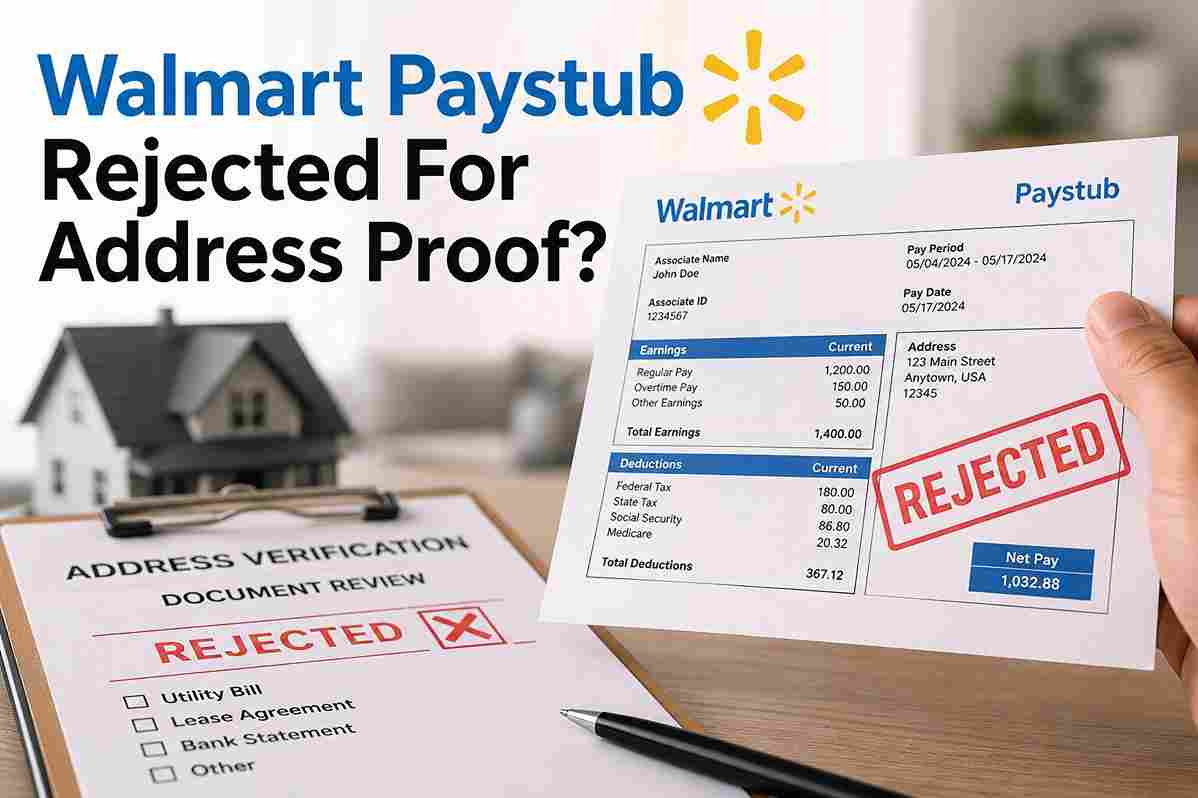
A homeowner schedules a new home security installation after moving into a recently rented townhouse. Everything seems straightforward until the security company requests proof of address before confirming the installation date. The homeowner has not yet received a utility bill, the lease paperwork is stored in another location, and most personal records are digital. While searching for acceptable documents, they notice that their employer-issued Walmart paystub contains their name and residential address. Naturally, they wonder whether a digital pay record could satisfy the requirement.
Questions like this have become increasingly common as businesses shift away from paper documentation. Employees often access payroll information through online portals instead of receiving printed records. A digital paystub may contain personal details, earnings information, tax data, and sometimes a home address. For workers employed by large companies, including those who access a Walmart paystub through an online payroll system, the document may appear official enough to support address verification.
However, whether a paystub can serve as proof of address during a home security installation depends on several factors. Security providers, financing partners, and installation companies often follow different verification policies. Some accept employer-issued documents as supporting evidence, while others require traditional records such as utility bills or lease agreements.
Understanding these requirements before scheduling an installation can save time, prevent delays, and help homeowners prepare the right documentation from the beginning.
Why Home Security Companies Ask for Proof of Address
Home security providers do more than install cameras, sensors, and alarms. They also verify that customers legitimately occupy the property where services will be installed.
Several practical reasons explain why proof of address is often required.
Fraud Prevention
Security equipment can be expensive. Some systems include financed hardware, professional monitoring agreements, and long-term service contracts.
Address verification helps providers reduce fraudulent orders and confirm that applicants have a legitimate connection to the property.
For example, someone attempting to order equipment for a property they do not own or occupy may struggle to provide acceptable address documentation.
Service Eligibility
Not every address qualifies for the same installation services.
Certain neighborhoods may have different service availability, monitoring coverage, or equipment requirements. Confirming the installation address ensures the provider can deliver the requested service.
Equipment Financing Verification
Many security companies offer financing options that allow customers to spread equipment costs over several months or years.
Lenders often require proof that the applicant resides at the listed address. This reduces lending risk and helps verify identity.
Identity Checks
Address verification frequently works alongside identity verification.
A provider may compare:
- Government-issued identification
- Customer application details
- Credit bureau information
- Residential documentation
Matching records help confirm that the customer is who they claim to be.
Installation Logistics
Technicians need accurate property information before arriving for installation.
Incorrect addresses can create scheduling issues, travel delays, and service complications. Verification helps prevent these problems before installation day.
What Documents Are Commonly Accepted as Proof of Address

Most home security companies rely on documents that clearly connect an individual to a physical residence.
The following records are commonly accepted.
| Document Type | Commonly Accepted? | Why It Works |
| Utility Bill | Yes | Shows active service at the residence |
| Bank Statement | Yes | Displays customer name and address |
| Lease Agreement | Yes | Demonstrates legal occupancy |
| Mortgage Statement | Yes | Confirms property ownership |
| Insurance Document | Often | Links policyholder to property |
| Government Correspondence | Yes | Considered highly reliable |
| Property Tax Statement | Yes | Confirms ownership details |
| Vehicle Registration | Sometimes | Shows registered residential address |
These documents are widely accepted because they originate from trusted organizations that regularly verify customer information.
A utility bill remains one of the strongest forms of proof because it demonstrates active usage at the property. Security providers often favor utility records because they are recent, difficult to falsify, and directly connected to a physical location.
Understanding Digital Paystubs and Address Information
Payroll systems have changed dramatically over the last decade.
Instead of receiving printed checks and paper records, employees commonly access earnings information through secure online portals.
A digital paystub typically contains:
- Employee name
- Employee identification number
- Employer information
- Pay period dates
- Earnings details
- Tax withholding information
- Benefit deductions
- Direct deposit details
- Residential address (when maintained in payroll records)
Because employers use payroll data for tax reporting and legal compliance, employee records are generally expected to be accurate.
That said, payroll accuracy depends partly on the employee. If an employee forgets to update their address after moving, the paystub may display outdated information.
Can a Walmart Paystub Show a Residential Address?
Many employees access payroll records electronically through employer payroll systems. In many cases, a Walmart paystub includes personal identifying information such as the employee’s name and mailing address.
The exact format can vary depending on:
- Payroll platform updates
- Employment status
- Internal company changes
- State-specific requirements
Because payroll systems evolve, not every Walmart paystub will display identical information.
Employees should review the document carefully before assuming it can be used for address verification.
Why Address Information Matters on a Walmart Paystub
A document that lacks an address generally provides little value for residential verification.
If a Walmart paystub clearly displays:
- Full legal name
- Current residential address
- Recent pay period information
- Employer identification
It may serve as supporting evidence during the verification process.
However, many organizations still classify paystubs as secondary documentation rather than primary proof of address.
Employer Records Are Only as Current as Employee Updates
A common issue occurs when workers move but forget to update payroll records.
Imagine an employee relocates in March but does not update employer information until June. Their digital paystub may continue showing the previous address for several payroll cycles.
In that situation, the document would not accurately verify current residency.
This is one reason some security providers prefer utility bills or lease agreements over employer-generated records.
Can a Walmart Paystub Be Used as Proof of Address for Home Security Installation?

The short answer is: sometimes.
Acceptance depends on company policies, financing requirements, and the specific information shown on the document.
Situations Where It May Be Accepted
A Walmart pay stub may be accepted when:
- It shows a current residential address
- The document is recent
- The customer’s name matches other records
- The provider allows secondary address documentation
- Additional supporting documents are available
Some local installers use flexible verification procedures, especially when financing is not involved.
For example, a small regional security company may accept a paystub alongside a government-issued photo ID.
Situations Where It May Be Rejected
Some providers require stricter documentation.
A paystub may be rejected if:
- No address appears on the document
- The address is outdated
- Financing rules require primary proof of residence
- Provider policies specifically exclude payroll records
- Information conflicts with application details
National providers often rely on standardized verification procedures that leave little room for exceptions.
Why Security Providers Have Different Rules
Not every security company faces the same level of risk.
A local installer that performs basic camera installations may have fewer verification requirements than a provider offering:
- Long-term monitoring contracts
- Equipment financing
- Smart home integration packages
- Credit-based approval programs
Because of these differences, one company may accept a Walmart pay stub while another may require a utility bill and lease agreement.
What Home Security Providers Usually Require During Verification
Verification requirements often involve several steps rather than a single document review.
Step 1: Identity Verification
The customer submits identification such as:
- Driver’s license
- State identification card
- Passport
The provider confirms personal details.
Step 2: Address Validation
The provider reviews residential documents to verify occupancy.
Acceptable records vary by company policy.
Step 3: Credit Review
If financing is involved, a credit evaluation may occur.
Address consistency helps support the application.
Step 4: Property Confirmation
The installation address is checked against service records and internal databases.
Step 5: Service Agreement Approval
Customers review installation terms, monitoring agreements, and billing information before activation.
When a Digital Paystub May Help Support Address Verification
A digital paystub is rarely the first document a security company requests. Even so, it can play a useful role when combined with other records.
Many providers look at the overall consistency of a customer’s documentation rather than relying on a single source. If several documents show the same address, the verification process becomes much easier.
Supporting Other Documents
Consider a homeowner who recently moved into a new apartment.
They may have:
- A signed lease agreement
- A driver’s license that still shows the old address
- A recent digital paystub displaying the new address
In this situation, the paystub can help support the lease agreement by showing that the employee has already updated their payroll records.
Assisting During Address Matching
Verification teams often compare information across multiple sources.
They may review:
- Customer application details
- Identification documents
- Credit records
- Residential documentation
- Employee pay records
If the address listed on each document matches, approval is usually faster.
Useful During Recent Moves
People who recently relocated often face documentation challenges.
Utility accounts may not yet be established. Government records may still reflect the previous residence. Insurance documents may be pending updates.
A recent digital paystub can sometimes bridge that gap until more traditional proof-of-address documents become available.
Example Scenario
Sarah moves into a newly purchased home and schedules professional alarm installation.
Her first utility bill will not arrive for another three weeks. The security provider requests proof of residence before installation.
Sarah submits:
- Mortgage closing documents
- Driver’s license
- Recent digital paystub
Because all three records show the same address, the verification team approves the installation without delay.
This example demonstrates how a paystub may serve as supporting evidence even when it is not the primary document.
Potential Problems with Using a Walmart Paystub Alone

Although employer-issued payroll records can be useful, relying solely on a paystub creates several challenges.
Missing Address Information
Not every Walmart paystub displays a residential address.
Some payroll systems emphasize compensation details and employee identification while minimizing personal information.
If the address is missing, the document provides little value for address verification.
Outdated Employee Records
Payroll databases only reflect the information employees provide.
Suppose an employee moves from one city to another but forgets to update payroll records for several months.
The address appearing on the paystub would no longer represent the employee’s current residence.
Security providers understand this possibility and may hesitate to rely solely on payroll records.
Employer Formatting Differences
Large employers periodically update payroll software.
As a result, one Walmart paystub may look different from another depending on:
- Payroll provider
- Employment classification
- State requirements
- System updates
These formatting differences can affect how verification teams interpret the document.
Installer Policy Restrictions
Some companies simply do not accept paystubs as proof of address.
Their internal policies may specify that only certain documents qualify.
For example, a provider may require one document from the following list:
- Utility bill
- Lease agreement
- Mortgage statement
- Government correspondence
In such cases, even a detailed paystub may not satisfy requirements.
Practical Example
A customer submits only a Walmart paystub when applying for a financed security system.
The financing partner rejects the document because company policy requires either a utility bill or bank statement dated within the last 60 days.
The paystub itself is legitimate, but it does not meet the lender’s documentation standards.
This situation highlights why customers should verify requirements before relying on payroll records.
Best Alternatives If Your Walmart Paystub Is Not Accepted
If a security provider declines a paystub, several alternatives are widely accepted.
These documents generally carry more weight because they directly connect an individual to a residence.
Proof of Address Checklist
Use one or more of the following:
- Recent electricity bill
- Water bill
- Natural gas bill
- Internet service bill
- Bank statement
- Credit card statement
- Signed lease agreement
- Mortgage statement
- Homeowners insurance declaration page
- Property tax statement
- Vehicle registration
- Government-issued correspondence
- Voter registration documents
- State tax records
Why Utility Bills Often Rank Highest
Utility companies verify customer addresses before activating service.
Because of this verification process, utility bills are commonly viewed as reliable proof of occupancy.
A recent utility bill often satisfies address verification requirements on its own.
Lease Agreements for Renters
Renters may not always have utilities in their name.
In these cases, a signed lease agreement frequently serves as the strongest alternative.
Many security companies accept leases because they establish legal occupancy of the property.
Government Documents Carry Strong Credibility
Government-issued correspondence typically undergoes verification procedures before being mailed.
Examples include:
- Tax notices
- Vehicle registration records
- Social service documents
- Official election materials
These records often receive high trust scores during verification reviews.
How to Prepare Documents Before Scheduling a Security System Installation

Preparing documentation ahead of time can prevent delays and rescheduling fees.
Follow these steps before booking an installation appointment.
Step 1: Gather Identification
Collect at least one government-issued photo ID.
Examples include:
- Driver’s license
- State ID card
- Passport
Ensure the document is current and readable.
Step 2: Confirm Address Consistency
Review every document you plan to submit.
Check that:
- Street address matches
- Apartment numbers match
- ZIP codes match
- Name spelling is consistent
Small discrepancies can slow the verification process.
Step 3: Download Recent Records
If documents are stored electronically, download fresh copies.
Recent records are generally preferred over older statements.
Examples include:
- Current bank statements
- Recent utility bills
- Updated payroll records
Step 4: Contact the Provider Beforehand
Requirements vary widely.
A quick phone call can clarify:
- Accepted documents
- Digital document policies
- Financing requirements
- Additional verification needs
This step often prevents unnecessary paperwork.
Step 5: Keep Backup Documents Available
Always prepare more than one document.
For example:
Primary document:
- Utility bill
Backup documents:
- Lease agreement
- Insurance statement
- Digital paystub
Having alternatives ready helps resolve unexpected verification requests quickly.
Frequently Asked Questions
Is a Walmart paystub considered an official proof of address document?
A Walmart paystub is an official payroll document issued by an employer. However, many security providers classify it as supporting documentation rather than primary proof of address. Acceptance depends on company policies.
Do all home security companies accept digital documents?
No. Many companies accept digital records, but requirements differ. Some providers may request printed copies or documents downloaded directly from official sources.
Can I use a paystub if my utility bill is not in my name?
Possibly. A paystub may help support your application, especially when paired with a lease agreement or other residency records. Contact the provider to confirm acceptable alternatives.
What documents work best for address verification?
Utility bills, lease agreements, mortgage statements, government correspondence, and bank statements are among the most widely accepted forms of proof of address.
Does a digital paystub need to be printed?
Not always. Many providers accept electronic copies. Some may request PDF versions downloaded directly from employer payroll systems.
Can renters use alternative documents?
Yes. Renters frequently use lease agreements, renter’s insurance documents, bank statements, and government-issued mail to verify residency.
How recent should proof-of-address documents be?
Most companies prefer documents issued within the last 30 to 90 days. Recent records provide stronger evidence of current residency.
Can a security company reject a document even if it shows my address?
Yes. A document may contain a valid address but still fail to meet company policy requirements. Acceptance depends on the provider’s verification standards.
Conclusion
Digital documentation has become a normal part of modern life, and employer-issued payroll records are easier to access than ever before. For many workers, a Walmart paystub contains valuable personal information that may help support address verification efforts during a home security installation.
Still, a paystub should not automatically be viewed as a guaranteed substitute for traditional proof-of-address documents. Security providers, financing partners, and installation companies often maintain their own verification standards. Some may accept a Walmart paystub as supplemental evidence, while others require utility bills, lease agreements, mortgage statements, or government-issued correspondence.
The safest approach is to verify documentation requirements before scheduling an installation. Preparing multiple forms of proof can prevent delays, speed up approval, and ensure a smoother installation experience.
If you plan to use a Walmart pay stub during the verification process, treat it as one piece of a larger documentation package rather than your only source of proof. A few minutes spent gathering backup records can save days of frustration later and help keep your installation on schedule.


Leave a Reply