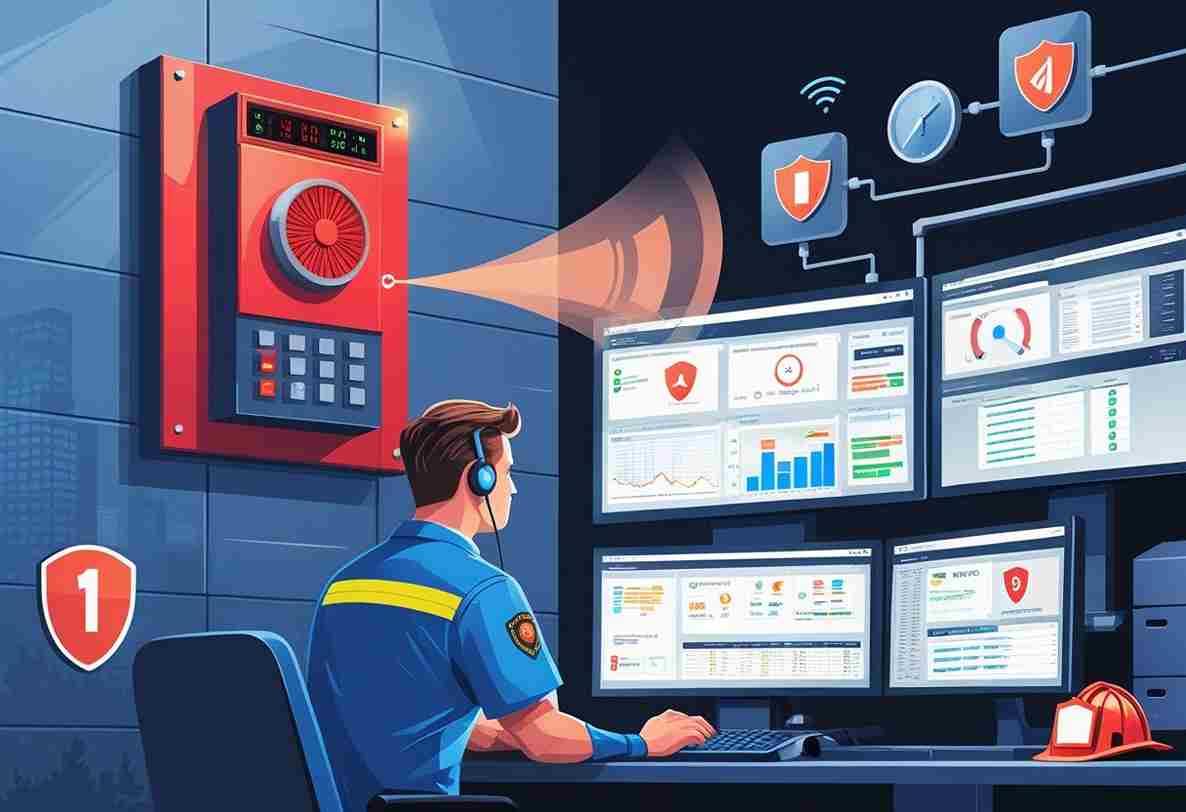
At 2:17 a.m., a smoke detector begins sounding in a two-story home. The family is asleep upstairs. Downstairs, an overloaded power strip behind a television stand has started a small electrical fire alarm monitoring. A notification appears on the homeowner’s phone, but the device is set to silent mode and charging in another room. Several minutes pass before anyone notices the alarm.
Fire emergencies differ from burglary alerts in one critical way: every minute matters. A delayed response to a break-in may result in property loss, but a delayed response to a fire can threaten lives, destroy a home, and dramatically increase repair costs. According to fire safety experts, a small fire can spread rapidly within minutes, especially in modern homes filled with synthetic materials.
This is where fire alarm monitoring enters the conversation. Instead of relying solely on app notifications or someone hearing an alarm, a professional monitoring center receives the signal and can initiate emergency response procedures around the clock.
This article examines how professional monitoring works, what it costs, how it compares to self-monitoring, and whether the monthly fee delivers enough value for homeowners and small business owners.
What Is Professional Fire Alarm Monitoring?

Many people assume that all smoke detectors work the same way. In reality, there is a significant difference between a standard smoke alarm and a monitored fire protection system.
How Fire Alarm Monitoring Works
A monitored system connects fire detection devices to a professional monitoring center that operates 24 hours a day.
Common components include:
- Smoke detectors
- Heat detectors
- Carbon monoxide detectors
- Fire alarm control panels
- Cellular or internet communication modules
When one of these devices detects a potential fire event, it sends a signal to the monitoring center. Trained operators then follow established procedures to verify the alarm and coordinate emergency response if necessary.
Most modern systems use multiple communication paths. If internet service fails, a cellular backup can continue transmitting alarm signals.
This redundancy is one reason many property owners invest in fire alarm monitoring rather than relying entirely on smartphone alerts.
What Happens During a Fire Alarm Event
The process typically follows these steps:
- A smoke or heat detector senses danger.
- The alarm panel receives the signal.
- The monitoring center receives the notification.
- Operators review the event.
- Emergency contacts may be notified.
- Fire department dispatch procedures begin when required.
- The homeowner receives additional notifications and updates.
The exact sequence varies by provider and local regulations, but the goal remains the same: reduce delays between fire detection and emergency response.
Fire Alarm Monitoring vs Self-Monitoring

Both monitoring approaches have advantages. Understanding the differences helps determine whether a monthly subscription makes sense for your situation.
Self-Monitored Fire Alarm Systems
Self-monitoring has become increasingly popular because many smart home devices now send alerts directly to smartphones.
Advantages
- No monthly monitoring fees
- Greater control over notifications
- Simple setup in many cases
- Lower long-term operating costs
Disadvantages
- Dependence on internet connectivity
- Reliance on smartphone notifications
- Delayed response if the owner is unavailable
- Potential missed alerts during sleep or travel
A self-monitored system can work well if someone is almost always available to receive alerts and respond quickly.
Professionally Monitored Fire Alarm Systems
Professional monitoring introduces an additional layer of protection by involving a dedicated response center.
Advantages
- 24/7 monitoring coverage
- Faster escalation procedures
- Backup response when owners are unavailable
- Added peace of mind during travel
Disadvantages
- Monthly subscription costs
- Possible contract commitments
- Higher overall ownership expenses
For many households, fire alarm monitoring serves as insurance against situations where nobody is available to react to an alarm immediately.
| Feature | Self-Monitoring | Professional Monitoring |
| Monthly Fee | None | Yes |
| Smartphone Alerts | Yes | Yes |
| 24/7 Monitoring Center | No | Yes |
| Emergency Escalation | Owner Responsible | Monitoring Center Assists |
| Backup Response | No | Yes |
| Travel Protection | Limited | Strong |
| Ongoing Cost | Low | Moderate |
Real Costs of Fire Alarm Monitoring

One of the biggest questions homeowners ask is whether the monthly fee justifies the benefits.
Typical Monthly Monitoring Fees
Residential monitoring costs vary significantly depending on provider, equipment, and service level.
Typical ranges include:
- Basic monitoring: $10-$20 per month
- Standard monitoring: $20-$40 per month
- Advanced monitoring with cellular backup: $40-$60 per month
Commercial properties often pay higher rates because of larger systems and regulatory requirements.
While these costs may seem modest monthly, they become more substantial over time.
Installation and Equipment Costs
Equipment expenses depend on the complexity of the system.
A typical residential setup may include:
- Smoke detectors
- Heat detectors
- Alarm control panel
- Communication module
Homeowners commonly spend between $300 and $1,500 on equipment and installation.
Larger homes and businesses may require significantly higher investments.
Long-Term Ownership Costs
Consider a homeowner paying $30 per month for monitoring.
One-Year Cost
Monitoring:
$30 × 12 = $360
Five-Year Cost
Monitoring:
$30 × 60 = $1,800
Ten-Year Cost
Monitoring:
$30 × 120 = $3,600
Adding equipment costs may bring total ownership expenses closer to $4,000-$5,000 over a decade.
At first glance, this appears expensive. However, comparing these costs against potential fire losses provides important perspective.
According to insurance industry estimates, even relatively small residential fires can cause tens of thousands of dollars in damage. Larger fires may result in six-figure losses.
Situations Where Fire Alarm Monitoring Is Worth the Cost

Not every homeowner needs professional monitoring. However, certain situations increase its value significantly.
Families With Children
Parents often prioritize safety systems because children may not recognize fire dangers quickly.
Imagine a family vacationing several hours away while a fire starts because of an appliance malfunction. A monitored system can initiate response procedures even when nobody is home.
Many parents view fire alarm monitoring as an additional safety layer rather than simply another monthly bill.
Elderly Homeowners
Older adults may face challenges hearing alarms, moving quickly during emergencies, or responding to smartphone notifications.
Monitoring provides support when immediate action becomes more difficult.
Family members often appreciate knowing that emergency signals are being observed around the clock.
Vacation Homes
Vacation properties frequently remain empty for days or weeks at a time.
Without monitoring, a fire could continue burning for an extended period before anyone notices.
Professional monitoring significantly reduces that risk by ensuring alarm signals reach a response center immediately.
Rental Properties
Landlords cannot be present at every property.
Monitoring can help protect both tenants and investment properties while reducing the chances of extensive damage from delayed emergency response.
Small Businesses
Many small businesses store valuable inventory, equipment, and records on-site.
A fire after business hours may go undetected until employees arrive the next morning.
For these organizations, fire alarm monitoring often provides meaningful protection against potentially devastating losses.
Situations Where Fire Alarm Monitoring May Not Be Necessary
Professional monitoring offers clear advantages, but it is not automatically the right choice for every property. Some homeowners may find that self-monitoring provides adequate protection based on their living situation and risk profile.
Tech-Savvy Homeowners

Some homeowners maintain highly connected smart homes and actively manage their security systems.
For example, a remote worker who spends most of the day at home may respond quickly to alarms and notifications. If multiple family members also receive alerts, the likelihood of missing an alarm decreases.
Even so, self-monitoring still depends on people noticing and responding to alerts promptly. The question becomes whether that level of reliance feels acceptable.
Small Apartments

A small apartment with limited square footage often allows occupants to hear alarms quickly.
In many cases:
- Occupants are close to smoke detectors.
- Fire alarms are easier to hear.
- Building-wide alarm systems may already exist.
- Property management may provide additional protection.
For some apartment residents, paying a monthly monitoring fee may offer less value than it would for a large detached home.
How Much Faster Is Professional Response?

One of the strongest arguments for monitoring involves response time. Fire growth is measured in minutes, not hours.
Why Minutes Matter During a Fire
According to fire safety research, modern residential fires can spread faster than many people realize. Synthetic furniture, plastics, and modern building materials often burn more rapidly than older household contents.
A fire that starts in a living room can grow dramatically within several minutes. As temperatures rise, smoke production increases, reducing visibility and making evacuation more difficult.
This is why emergency responders emphasize early detection and rapid notification.
The primary advantage of fire alarm monitoring is that it reduces the number of steps between fire detection and emergency action.
Instead of relying on someone to:
- Notice the alarm.
- Confirm the situation.
- Find a phone.
- Contact emergency services.
A monitoring center may already be processing the alarm signal.
Common Causes of Delayed Emergency Calls
Many people assume they will always see notifications immediately. Real-world situations often prove otherwise.
Common causes of delays include:
Phone on Silent Mode
Many users silence phones during meetings, sleep, or work hours.
A critical notification can easily be overlooked.
Dead Battery
A phone cannot deliver alerts if it has no power.
This simple issue causes more missed notifications than many homeowners realize.
Poor Signal
Cellular coverage problems or internet outages may prevent notifications from reaching users promptly.
User Away From Home
Travel creates another challenge.
A homeowner on a flight or in an area with poor connectivity may not see an alert until much later.
Notification Overload
People receive dozens or even hundreds of notifications daily.
Important alerts sometimes become lost among less urgent messages.
Professional monitoring helps address these common failure points by creating a dedicated response pathway.
Insurance Benefits of Fire Alarm Monitoring

Insurance savings rarely justify monitoring on their own, but they can offset part of the monthly cost.
Potential Insurance Discounts
Some insurance companies offer discounts for monitored fire protection systems.
Discount levels vary, but homeowners may receive reductions ranging from approximately 2% to 15%, depending on:
- Property type
- Insurance provider
- Monitoring certification
- Installed equipment
A homeowner paying $1,500 annually for insurance could potentially save between $30 and $225 per year.
While this may not cover the entire monitoring fee, it can reduce overall ownership costs.
Documentation and Verification Advantages
Monitored systems often generate detailed event records.
These records may include:
- Alarm activation times
- Device information
- Response logs
- Monitoring center actions
Documentation can help during insurance investigations following a fire-related claim.
Accurate timelines often simplify claims processing.
Faster Damage Mitigation
A small fire contained quickly may cause thousands of dollars in damage.
A delayed response can increase losses dramatically.
For example:
- Early response damage: $8,000
- Delayed response damage: $60,000+
While outcomes vary, earlier intervention often reduces both repair costs and recovery time.
This is one reason many property owners view fire alarm monitoring as a risk-management investment rather than merely a recurring expense.
How to Decide If Fire Alarm Monitoring Is Right for You

The best decision depends on your property, household, and risk tolerance.
Ask yourself the following questions.
Property Occupancy
- Is the property frequently empty?
- Do family members travel often?
- Is anyone usually home during the day?
The more time a property spends unoccupied, the stronger the case for monitoring.
Household Considerations
- Are children living in the home?
- Are elderly residents present?
- Would occupants reliably hear alarms at night?
Monitoring often provides greater value in these situations.
Connectivity Reliability
- Is internet service dependable?
- Does cellular backup exist?
- Have notification issues occurred before?
Weak connectivity increases reliance on professional monitoring infrastructure.
Property Risk Factors
Consider:
- Older electrical systems
- Extensive appliance usage
- Attached garages
- Heating equipment
- Wood-burning fireplaces
Higher-risk environments may justify additional protection.
Property Value
The more valuable the property and contents, the greater the potential financial impact of a major fire event.
Decision Checklist
Professional monitoring may be worth considering if you answer “yes” to several of these questions:
- Home frequently empty
- Family travels regularly
- Children or elderly occupants present
- High-value property
- Rental property ownership
- Small business operation
- Desire for backup emergency response
FAQ
1. What is fire alarm monitoring?
Fire alarm monitoring is a service that connects smoke detectors and alarm systems to a professional monitoring center that receives alarm signals and helps coordinate emergency response.
2. How much does professional monitoring cost?
Most residential plans range from approximately $10 to $60 per month depending on equipment, provider, and service level.
3. Does monitoring automatically call the fire department?
Procedures vary by provider and jurisdiction. Monitoring centers typically follow verification and dispatch protocols established by local regulations and service agreements.
4. Can smart smoke detectors replace monitoring?
Smart detectors improve awareness but do not provide dedicated monitoring-center oversight. They complement monitoring rather than fully replacing it.
5. Is monitoring worth it for small homes?
It can be, especially if the home is frequently vacant or occupants may miss alarms. However, some small homes may find self-monitoring sufficient.
6. Do insurance companies offer discounts?
Many insurers provide discounts for monitored systems, although savings vary significantly between providers.
7. What happens if the internet goes down?
Many monitored systems use cellular backup communication paths that continue transmitting alarm signals during internet outages.
8. How quickly do monitoring centers respond?
Response times vary, but professionally monitored systems are designed to process alarm signals immediately and begin established response procedures without waiting for homeowners to notice notifications.
Conclusion
Professional monitoring is not essential for every property, but it can provide meaningful benefits in the right circumstances. Homes that are frequently vacant, properties occupied by children or elderly residents, rental units, vacation homes, and small businesses often gain the most value from added monitoring support.
Self-monitoring may be sufficient for some homeowners, particularly those who are almost always present, highly engaged with their smart home systems, and comfortable managing alerts themselves. However, self-monitoring still depends on someone noticing and responding to an alarm.
The biggest advantage of fire alarm monitoring is not convenience. It is the additional layer of protection that exists when nobody is available to act. If reducing response delays, improving emergency preparedness, and protecting valuable property are priorities, reviewing monitored fire protection options may be a worthwhile next step.


Leave a Reply