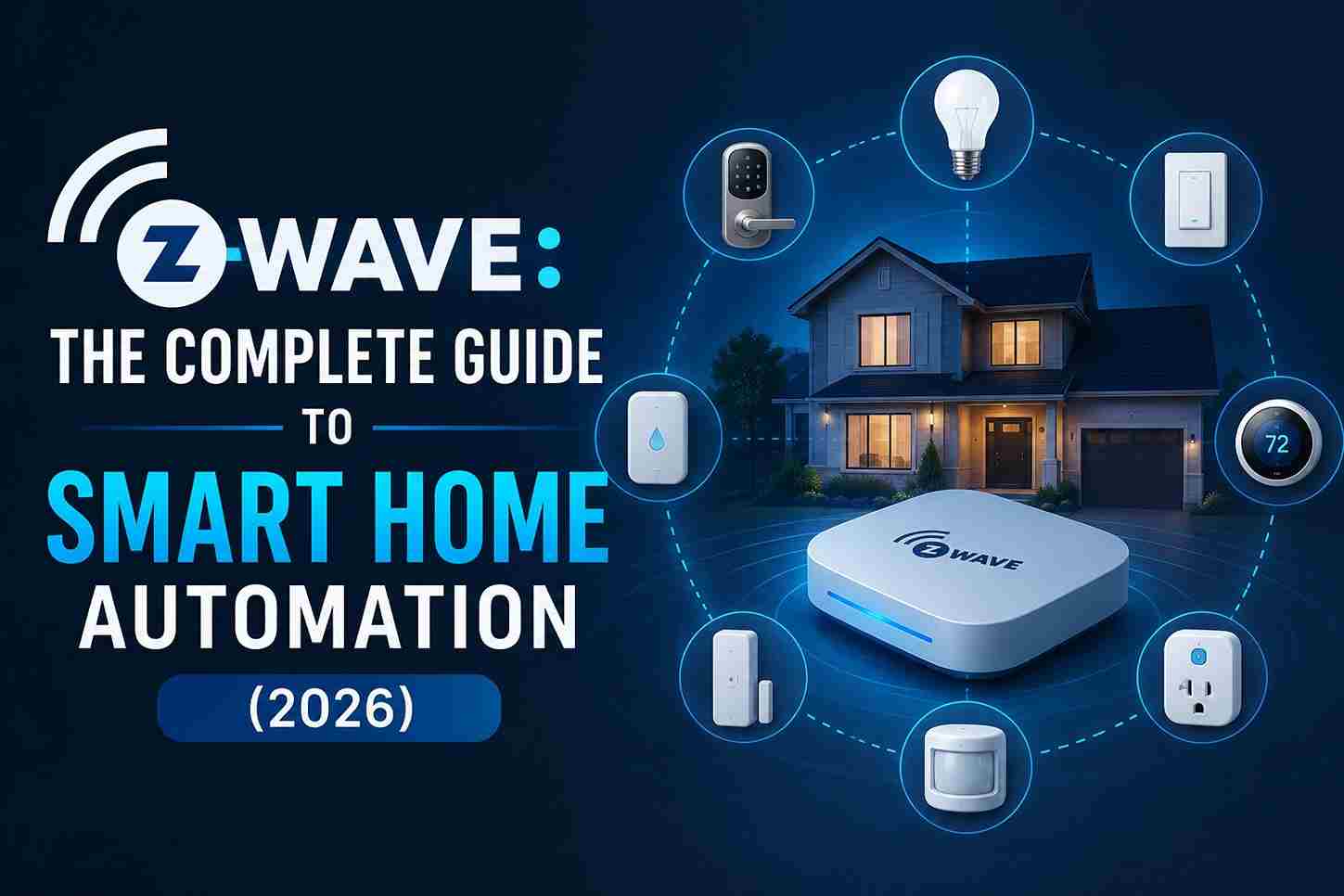
Z-Wave is one of the most widely adopted wireless communication technologies for smart home automation. Designed specifically for connected devices, it enables smart locks, lighting, switches, sensors, thermostats, and other equipment to communicate reliably using a secure, low-power mesh network.
Unlike Wi-Fi, which focuses on high-speed internet connectivity, it is optimized for dependable device-to-device communication and home automation. Its low power requirements, strong interoperability standards, and extensive device ecosystem have made it a popular choice for homeowners building scalable smart homes.
Whether you’re installing a few smart switches or automating an entire house, understanding how it works will help you create a more reliable and efficient smart home. If you’re new to connected homes, start with our Complete Home Automation Guide to understand how controllers, wireless protocols, and smart devices work together.
What is Z-Wave?

It is a wireless communication protocol developed specifically for home automation.
Rather than relying on traditional Wi-Fi networking, devices communicate directly with one another through a mesh network. Each powered device can relay messages, allowing signals to travel throughout the home even if the controller is located some distance away.
This architecture improves reliability while reducing power consumption, making it particularly well suited for battery-powered devices.
Today, thousands of certified products support Z-Wave, including:
- Smart Locks
- Smart Switches
- Smart Lighting
- Motion Sensors
- Door Sensors
- Water Leak Sensors
- Thermostats
- Garage Door Controllers
- Smart Plugs
- Energy Monitoring Devices
History of Z-Wave
It was introduced in 2001 as one of the first wireless technologies dedicated entirely to home automation.
Over time, it evolved into one of the largest ecosystems for connected home devices.
Major milestones include:
- Introduction of mesh networking
- Improved device interoperability
- Enhanced encryption standards
- Better battery efficiency
- Support for SmartStart provisioning
- Expansion into thousands of certified products
Today, it continues to power millions of smart homes worldwide.
How Z-Wave Works

This network consists of three primary components:
Controller
The controller serves as the central coordinator for the network.
Examples include:
- Vera Controllers
- SmartThings Hub
- Home Assistant with adapter
- Hubitat Elevation
The controller manages devices, stores automation rules, and coordinates communication.
End Devices
End devices perform actions or gather information.
Examples include:
- Smart Locks
- Smart Switches
- Smart Plugs
- Thermostats
- Motion Sensors
- Contact Sensors
- Smoke Detectors
Each device joins the network through the controller.
Repeaters
Powered devices automatically function as repeaters.
Examples include:
- Wall switches
- Smart plugs
- Wired dimmers
Repeaters strengthen the mesh network by forwarding messages between devices.
Battery-powered devices generally do not repeat signals.
Z-Wave Frequency
Unlike Wi-Fi and Zigbee, it operates on sub-GHz radio frequencies, helping reduce interference from common household wireless devices.
This offers several advantages:
- Less congestion
- Better wall penetration
- More reliable communication
- Stable performance in busy wireless environments
Because radio frequencies vary by region, devices should be purchased for the appropriate country to ensure compatibility.
Types of Z-Wave Devices

The ecosystem includes a wide range of products.
Smart Locks
Allow secure remote locking, unlocking, user management, and automation with entry events.
Smart Switches
Replace traditional wall switches while supporting scheduling, scenes, and automation.
Smart Lighting
Control brightness, schedules, scenes, and energy usage.
Motion Sensors
Detect movement for lighting, security, and occupancy-based automation.
Contact Sensors
Monitor doors, windows, cabinets, and gates.
Water Leak Sensors
Provide early warning of plumbing leaks and flooding.
Thermostats
Automatically adjust heating and cooling based on occupancy, schedules, or environmental conditions.
Smart Plugs
Control lamps and appliances while measuring energy consumption on compatible models.
Garage Door Controllers
Enable remote monitoring and control of garage doors with safety features and automation support.
Z-Wave Controllers
Every network requires a primary controller.
The controller is responsible for:
- Adding new devices
- Removing devices
- Creating automation rules
- Managing network health
- Scheduling routines
- Processing scenes
- Maintaining secure communication
Examples of compatible ecosystems include:
- Vera Controllers
- Hubitat
- Home Assistant
- SmartThings
Choosing a capable controller is essential for reliable long-term automation.
Z-Wave Security

Modern networks use advanced security mechanisms to protect communication between devices.
Security features include:
- AES-128 encryption
- Secure inclusion
- Device authentication
- Network encryption keys
- S2 Security Framework
- SmartStart provisioning support
These protections help reduce the risk of unauthorized access while simplifying secure device installation.
Advantages of Z-Wave
Homeowners choose Z-Wave because it offers several important benefits.
Reliable Mesh Networking
Powered devices strengthen the network as it grows.
Low Power Consumption
Battery-operated sensors often last several years before requiring replacement.
Excellent Interoperability
Certified devices from different manufacturers are designed to work together within the same network.
Strong Security
Modern encryption standards protect communications between devices and controllers.
Scalable Automation
Whether installing five devices or hundreds, Z-Wave is designed to support growing smart home systems.
Common Applications

It is used in a wide range of residential automation scenarios.
Popular applications include:
- Smart lighting control
- Whole-home security
- Climate management
- Leak detection
- Energy monitoring
- Garage automation
- Vacation mode
- Occupancy-based automation
- Remote property management
- Elderly care and accessibility support
Its flexibility makes Z-Wave suitable for apartments, family homes, and larger residential properties alike.