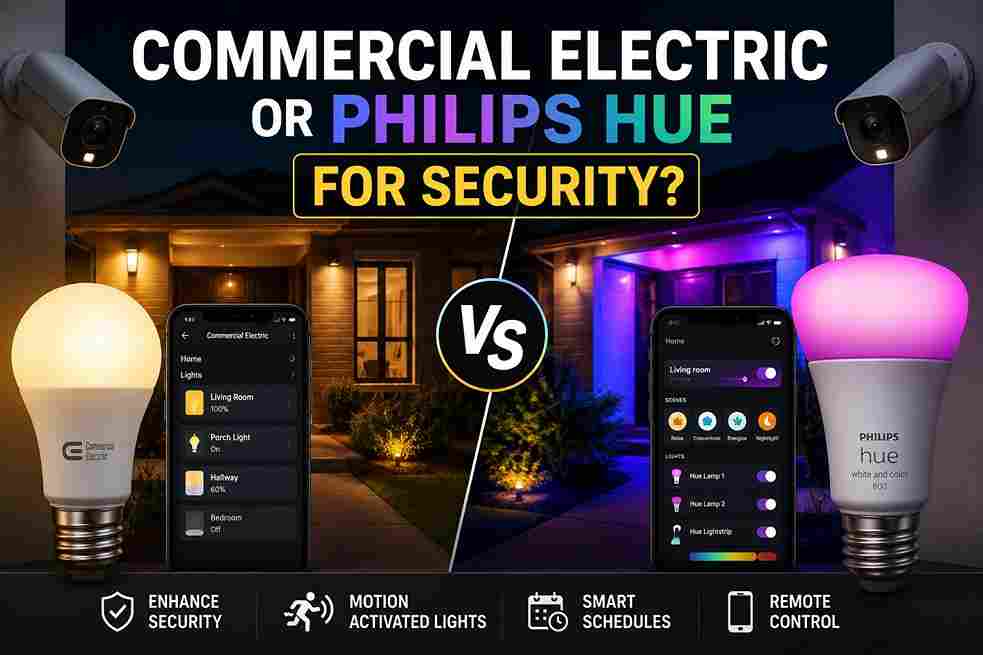
A homeowner leaves town for a week and wants the house to look occupied while they’re away. Instead of leaving lights on continuously, they schedule indoor lamps to turn on at sunset, dim later in the evening, and switch off at bedtime. Meanwhile, the porch lights activate automatically whenever a security camera detects motion. This type of automation is one of the simplest ways to improve home security without investing in a full alarm system. Two options that frequently appear on homeowners’ shopping lists are Commercial Electric smart lights and Philips Hue.
One is known for affordability and straightforward setup, while the other has built a reputation as a premium smart lighting ecosystem. Choosing between them isn’t just about brightness or color options. The right decision depends on your budget, automation goals, smart home platform, and long-term expansion plans.
In this guide, we’ll compare features, installation, reliability, security automation capabilities, pricing, and real-world performance. By the end, you’ll know which lighting system fits your home security strategy and whether spending more actually delivers meaningful benefits.
Why Smart Lighting Matters for Home Security

Most burglars prefer homes that appear unoccupied. Smart lighting helps solve that problem by creating realistic activity patterns even when nobody is home.
Instead of relying on traditional timers, smart lights can respond dynamically to conditions such as:
- Motion detection
- Sunset and sunrise schedules
- Camera alerts
- Door sensor activity
- Voice commands
- Mobile app controls
For example, a homeowner can create an automation that turns on entryway lights whenever a video doorbell detects movement after dark. This immediate response can discourage unwanted visitors while improving visibility for family members arriving home.
Lighting also works well alongside other security devices. Cameras capture clearer footage in illuminated areas, and motion-triggered lights often make properties less attractive targets. Proper Ring Stick Up Cam placement can further improve visibility and eliminate security blind spots around your property.
Commercial Electric Smart Lights Overview

Commercial Electric smart lighting products are commonly available through major home improvement retailers and are often positioned as budget-friendly alternatives to premium systems.
Many products connect directly through Wi-Fi, eliminating the need for additional hubs.
Key Features of Commercial Electric
Several features make Commercial Electric attractive for homeowners seeking affordable automation.
Common capabilities include:
- Remote app control
- Scheduling
- Voice assistant integration
- Dimming functionality
- Color-changing options on selected models
- Group controls for multiple lights
Most standard smart bulbs consume approximately 8 to 12 watts while producing brightness comparable to traditional 60-watt incandescent bulbs.
That translates into significant energy savings over time.
Supported Smart Home Platforms
Many Commercial Electric products support:
- Amazon Alexa
- Google Assistant
- Smart Life ecosystem
- Tuya-compatible platforms
For beginners, direct Wi-Fi connectivity simplifies setup because there is no separate bridge or hub to install.
However, depending on the product generation, automation flexibility can vary.
Philips Hue Overview

Philips Hue has become one of the most recognized names in smart lighting.
Rather than focusing primarily on affordability, Hue emphasizes reliability, advanced automation, ecosystem compatibility, and long-term scalability.
Key Features of Philips Hue
Philips Hue offers:
- White lighting
- White ambiance lighting
- Full-color lighting
- Motion sensor integrations
- Entertainment syncing
- Advanced scenes
- Geofencing
- Room-based automation
Hue bulbs typically last up to 25,000 hours under normal use, making them one of the longer-lasting options in the smart lighting market.
Supported Smart Home Platforms
Philips Hue works with:
- Amazon Alexa
- Google Home
- Apple HomeKit
- Samsung SmartThings
- IFTTT
- Matter-compatible ecosystems
This broad compatibility appeals to homeowners planning more advanced smart home installations.
Commercial Electric vs Philips Hue: Installation and Setup

Installation is often the first concern for homeowners.
Fortunately, both systems are relatively beginner-friendly.
Commercial Electric Setup Experience
Most Commercial Electric bulbs install like traditional bulbs.
The process usually involves:
- Installing the bulb
- Downloading the app
- Connecting to Wi-Fi
- Completing device pairing
Many homeowners can finish setup within 10 to 15 minutes.
The lack of a hub reduces complexity but places more dependence on Wi-Fi quality.
Philips Hue Setup Experience
Hue offers two setup paths:
- Bluetooth-only setup
- Hue Bridge setup
Bluetooth works well for small installations. However, most security-focused homeowners eventually add the Hue Bridge to unlock advanced automation capabilities.
Initial setup may take slightly longer, but the result is generally more robust.
Commercial Electric vs Philips Hue: Security Automation Features

Security automation is where differences become more noticeable.
Motion Detection Automations
- Motion-triggered lighting is one of the most valuable security features.
- With Philips Hue, homeowners can pair dedicated motion sensors to activate lights instantly when movement occurs.
For example:
A driveway sensor can trigger floodlights whenever a vehicle enters the property after sunset.
Many Commercial Electric products can achieve similar results through Alexa routines or third-party automations, but setup often requires additional configuration.
Vacation Mode and Presence Simulation
- One of the best deterrents against opportunistic crime is making a home appear occupied.
- Philips Hue includes advanced presence simulation features that vary lighting schedules naturally.
- Instead of turning lights on at exactly 7:00 PM every day, the system introduces subtle variations that look more realistic.
- Many Commercial Electric systems support scheduled lighting but may require manual configuration for similar effects.
Outdoor Security Lighting Integration
Outdoor lighting significantly improves security coverage.
Popular uses include:
- Driveway illumination
- Patio lighting
- Garage lighting
- Walkway lighting
A homeowner with a Ring camera can create routines that illuminate exterior areas whenever motion is detected.
Both systems support this type of automation, although Hue generally provides deeper integration options.
Commercial Electric vs Philips Hue: App Experience

App quality affects daily usability more than many buyers realize.
Commercial Electric App Experience
The experience varies somewhat depending on the app ecosystem being used.
Advantages include:
- Simple controls
- Fast setup
- Easy scheduling
However, advanced automation menus can sometimes feel less polished than premium competitors.
Philips Hue App Experience
Hue’s app is widely considered one of the strongest in the industry.
Features include:
- Room organization
- Scene management
- Automation templates
- Accessory controls
- Dynamic lighting effects
For homeowners building larger smart homes, the difference becomes increasingly noticeable.
Commercial Electric vs Philips Hue: Reliability and Connectivity

Reliability is critical for security-related automations.
Wi-Fi vs Hub-Based Design
Most Commercial Electric products rely directly on Wi-Fi.
Benefits include:
- Lower upfront costs
- Simpler installation
Potential drawbacks include:
- Router congestion
- Signal interference
- Greater dependence on wireless coverage
Hue’s bridge-based architecture reduces network traffic by using Zigbee communication between devices.
Real-World Connectivity Example
In a home with 40 connected devices, Wi-Fi congestion can occasionally affect performance.
A bridge-based solution often maintains more consistent responsiveness because smart bulbs communicate through a dedicated network rather than competing with phones, laptops, and streaming devices.
Commercial Electric vs Philips Hue: Pricing Comparison

Price often becomes the deciding factor.
Typical Starter Kit Costs
Typical pricing ranges include:
Commercial Electric:
- Single bulb: $8–$20
- Multi-pack kits: $20–$60
Philips Hue:
- Single white bulb: $15–$30
- Color bulb: $40–$60
- Starter kits: $70–$200+
These prices vary throughout the year but illustrate the general difference.
Long-Term Expansion Costs
Expansion costs matter more than many buyers expect.
A homeowner outfitting:
- Living room
- Kitchen
- Hallways
- Exterior lights
might install 15–20 smart bulbs.
At that scale, the price difference becomes substantial.
This is where Commercial Electric often wins for budget-conscious buyers.
Which System Is Better for Beginners?
For most beginners, Commercial Electric offers a lower barrier to entry.
Advantages include:
- Lower upfront investment
- Direct Wi-Fi setup
- Familiar installation process
- Basic automation capabilities
Someone experimenting with smart lighting for the first time may find it easier to start here.
The financial risk is simply lower.
Which System Is Better for Advanced Smart Homes?

Advanced users usually prioritize:
- Automation flexibility
- Reliability
- Ecosystem compatibility
- Expansion options
This is where Philips Hue frequently stands out.
A homeowner integrating:
- Cameras
- Sensors
- Smart locks
- Voice assistants
- Presence detection
will likely appreciate Hue’s broader automation ecosystem.
The premium price often becomes easier to justify when managing dozens of connected devices.
Common Mistakes Homeowners Make When Choosing Smart Lights

Many buyers focus solely on price.
However, several other factors deserve attention.
Ignoring Ecosystem Compatibility
Always verify compatibility with:
- Alexa
- Google Home
- Apple HomeKit
- SmartThings
Replacing incompatible products later becomes expensive.
Overlooking Wi-Fi Coverage
Weak wireless signals create frustration.
Before installing smart lights:
- Test coverage
- Identify dead zones
- Consider mesh networking if needed
Buying for Today’s Needs Only
Think beyond your current setup.
A homeowner who starts with three bulbs may eventually want:
- Motion sensors
- Cameras
- Outdoor lighting
- Automated routines
Planning can prevent future upgrades.
FAQ
Is Commercial Electric compatible with Alexa?
Yes. Many Commercial Electric smart lighting products support Amazon Alexa for voice control and automation routines.
Does Philips Hue require a hub?
Not always. Basic Bluetooth control works without a hub. However, the Hue Bridge unlocks the full feature set and advanced automation options.
Which system is better for security automation?
Philips Hue generally provides more advanced automation capabilities. However, Commercial Electric can still deliver effective security lighting at a lower cost.
Which option costs less?
In most situations, Commercial Electric products cost significantly less than comparable Hue products.
Can both systems work together?
Yes. Many homeowners operate both systems within the same smart home environment using Alexa, Google Home, or other compatible platforms.
Final Verdict
Choosing between Commercial Electric and Philips Hue depends less on which product is objectively better and more on how you plan to use it.
For homeowners focused on affordability, simple installation, and basic security automations, Commercial Electric provides excellent value. It allows users to create schedules, motion-based routines, and remote controls without a major investment.
Philips Hue, on the other hand, remains the stronger premium solution. Its bridge-based architecture, advanced automations, extensive ecosystem support, and proven reliability make it particularly appealing for larger smart home installations.
Here’s the simplest way to decide:
- Best budget choice: Commercial Electric
- Best premium choice: Philips Hue
- Best for security automation: Philips Hue
- Best for beginners: Commercial Electric
- Best for advanced smart homes: Philips Hue
If you’re just starting with smart lighting, begin with a few Commercial Electric bulbs and learn how automation fits into your daily routine. If your goal is building a comprehensive security-focused smart home that includes cameras, sensors, and advanced automations, Philips Hue is often worth the additional investment.

Leave a Reply